
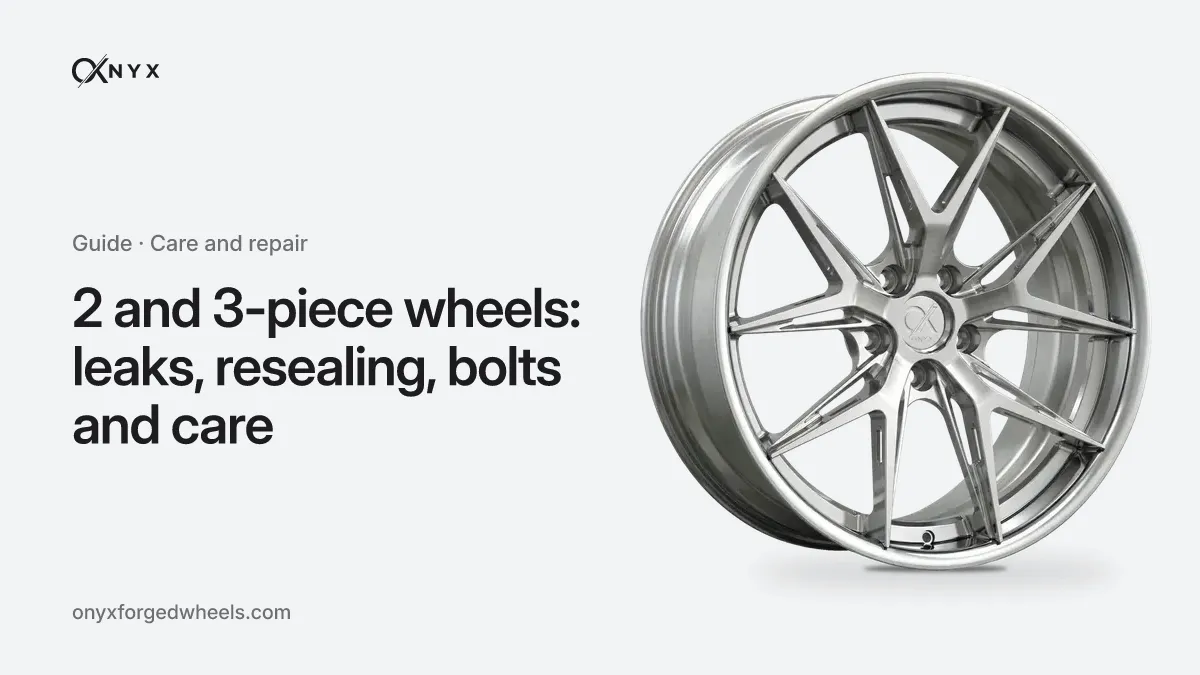
In short. A two- or three-piece wheel holds air in two ways: at the tyre bead, like any wheel, and at the joint where its bolted parts meet. So a slow leak with no puncture comes from the bead, the valve or that joint, and soapy water shows which. Leave the assembly bolts alone: none of the three wheel makers' instructions we read lets an owner or a tyre fitter loosen or retighten them, and only one of those makers publishes a torque figure, which applies to its own wheels. A tyre fitter keeps tools off the joint and off a polished lip. Cleaning means mild soap and a soft cloth. A wheel is resealed taken apart, with fresh sealant and the maker's torque, by the maker or by a shop that has the maker's figures.
To choose between the three constructions, start with monoblock vs two-piece vs three-piece wheels; for the names of the parts, see the parts of a wheel explained.
How a two- or three-piece wheel holds air
A two-piece wheel bolts a centre, which carries the spokes, to a barrel, which carries the bead seats and the lip. A three-piece wheel sets the centre between an outer and an inner barrel: two joints, two sets of bolts. UN Regulation No. 124, the rule used in Europe for replacement wheels, tells them apart even in the rim size code: "x" for a one-piece rim, "-" for a multi-piece rim (5.1.2.1).
With a tubeless tyre, the air presses on the barrel, so every joint between two parts must be airtight. ETRTO, the European tyre and rim standards body, puts it plainly: "All tubeless tyres must be fitted on air-tight rims" (Recommendations 2025, page 35). Regulation No. 124 asks a wheel designed for tubeless tyres to "ensure air retention" (6.2.1); its rolling trial accepts no air leakage (annex 7), and in its impact trial, a wheel whose parts can be taken apart fails if a threaded fastening close to the spoke or ventilation holes gives way (annex 8). In the United States, SAE J2530 (December 2024 edition), a paid document we have not read in full, adds terms for wheel constructions rarely used by car makers, according to its abstract.
What makes the joint airtight is the clamping force of the bolts and, depending on the maker, a sealant. One American maker warns that its multi-piece wheels "may have a special sealant between the rims and the centers".
Do 3-piece wheels leak? Why a bolted wheel loses air
ETRTO lists the usual sources of pressure loss: punctures, the tyre/rim interface (the bead), the valve, the valve/rim interface and the wheel itself (page 23). An assembled wheel adds its joint, and the instructions we read name four ways to damage it:
- a tyre tool touching the sealant: the seal "may be damaged and cause a leak", writes that American maker, which also asks for care with a valve that sits close to the seal;
- bolts loosened or retightened: a Japanese maker forbids retightening or loosening the rim bolts of its two-piece wheels, which it says wears the bolts and loosens the bond;
- disassembly: the first maker forbids taking its wheels apart and lists disassembly among the changes that can weaken the wheel or cause air leaks;
- an impact: a bent lip leaks at the bead; our reading is that the force that bends it also passes through the joint.
Finding the leak: bead, joint or valve
Test the wheel at its normal pressure with soapy water: a growing bubble marks the leak. On an assembled wheel, also check along the joint and around every bolt head.
| Where the bubbles are | What it points to | Who deals with it |
|---|---|---|
| on the tread | a puncture | the tyre fitter |
| at the base of the valve or the core | the valve or its seal in the wheel | a new valve, fitted without touching the joint |
| where the tyre meets the rim flange | the bead: dirty or corroded seat, damaged lip | tyre off, bead seat inspected |
| along the joint, around the bolt heads | the assembly joint | the wheel maker, or a shop with its figures |
| where the two half-barrels meet (three-piece) | the second joint | the wheel maker, or the same shop |
| nowhere, yet the pressure still drops | a very slow leak, or the inner face unseen | a dunk tank, wheel off the car |
The table is our summary of the sources cited. A leak around the bolt heads is not fixed by tightening them (see below). Meanwhile, check the pressure when the tyres are cold every two weeks, as ETRTO advises (page 23). For bead leaks and porous wheels, see our guide to tyre bead leaks and corroded rims.
What the tyre fitter must not do
Touch the assembly bolts. All three makers' instructions say so. A second American maker, of two- and three-piece wheels, writes that under no circumstances should anyone loosen or remove an assembly bolt, and explains why: with the tyre fitted and inflated, removing one can cause serious injury or death; the fasteners are "structural, not decorative". EUWA, the European wheel makers' association, takes the same line for divided bolted wheels: tyre fully deflated, valve core out, before the wheel even comes off the car, because unseen damage can make an assembly still under pressure explode (ES 1.09, point 2.2).
Put a tool on the joint or on a polished lip. The second American maker requires a "contact free" tyre machine and stick-on balance weights only; clip-on weights, it says, can damage its wheels. Our reading: a polished lip does not take the rub of a metal mounting head, so ask for protectors or a contact-free machine.
Ignore which side the well is on. When the drop centre well is not centred, ETRTO has the tyre fitted and removed from the side closest to the well and, in case of doubt, refers to the wheel maker (page 35). On an assembled wheel, our reading is that the well's position depends on the barrel chosen: ask.
The rest follows the general rules: a proper tyre lubricant, never hydrocarbons (ETRTO), silicone or solvents (Continental); a fitting pressure set by the tyre and wheel makers (ETRTO, page 34); a new snap-in valve with every new tyre (ETRTO, page 35). See our guide to mounting a tyre.
2-piece wheel bolts: the maker's torque, nothing else
| Source | What it says about the assembly bolts |
|---|---|
| American maker no. 1 | torqued to 25 ft-lb (33.9 N·m, our conversion) before delivery, no retightening needed; a bolt that looks loose: contact the maker |
| American maker no. 2 | nobody loosens or removes them; disassembly by anyone else voids the warranty |
| Japanese maker | tightened to its specified torque with its own rim bolts; never retighten or loosen; a loose bolt: stop using the wheel and see the dealer |
| American rebuild shop | torqued to the figure supplied by the wheel maker; all assembly hardware replaced, because torquing has stretched it |
Only one of the three makers publishes a figure, and it applies to its own wheels, bolts and sealant: using another maker's torque, or a number from a forum, is tightening blind. For an Onyx Forged wheel, ask customer service for the assembly torque. Our Terms and Conditions exclude from the warranty incorrect fitting, non-conforming bolts and unauthorised work by third parties after delivery (article 6.2).
Wheel nuts or bolts are another matter: car maker's torque, checked again after about 100 km (Japanese maker) or 100 miles, 161 km (first American maker).
How to reseal a 3-piece wheel, and what to use
Resealing means taking the wheel apart. An American wheel shop publishes its method:
- bolts removed one by one from the nut side, then all the old sealant taken off and the surfaces cleaned with denatured alcohol;
- new assembly hardware, since the old has been stretched by torquing, and new valves;
- a new, sealed tube of sealant for each job, a bead between barrel and centre, bolts started by hand, centre aligned, torqued to the maker's figure, then a bead along the gap between the barrels;
- a 24-hour cure, then the tyre at 35 psi (2.41 bar, our conversion), the pressure checked every day for 5 days before balancing.
What to use to seal a 3-piece wheel is the wheel maker's call: that shop uses silicone, fresh for each job. EUWA also asks for the contact surfaces of multi-piece rims to be cleaned and protected against corrosion (point 2.3). The shop adds a limit for hidden-bolt wheels, where the bolts screw into the centre: the threads wear, and such a wheel can be rebuilt only a few times before the centre must be replaced or redrilled by the maker. The OX-D5 Kinetic, our two-piece with hidden bolts, should therefore only be taken apart on our instructions: ask customer service.
3-piece wheel lip repair and rebuild
Light kerbing can be put right without splitting the wheel: the second American maker accepts light sanding and colour correction by a local repairer; disassembly, heating, bending or welding by anyone else voids its warranty. EUWA forbids repairing a rim "by heating, by welding, by addition or removal of material" (ES 1.09, point 2.3). For heavier damage, the construction helps: the first maker says its three-piece wheels "can almost always be repaired for far less than the cost of a new wheel", by the maker.
Cleaning: finish, lip and bolts
The makers' instructions agree:
- mild soap and water, a soft non-abrasive cloth; no harsh chemical cleaners, no spray-on, hose-off products (second American maker);
- no acidic, alkaline or abrasive cleaners, no cleaners for plated wheels, no iron fallout removers; avoid fast automatic car washes (Japanese maker);
- never a hot wheel: let it cool and wash in the shade (second American maker);
- wax on clear-coated, painted or chrome finishes, but not on bare polished surfaces (same maker);
- salt, snow or the seaside: wash with water after driving there (Japanese maker).
Visible bolts, titanium or gold on request at Onyx Forged, are cleaned like the rest of the face, with no wire brush or abrasive around the heads, where brake dust builds up. Road salt also limits our finish warranty (Terms and Conditions, article 6.2). See also how to clean alloy wheels, how to polish aluminium wheels for a polished lip, and how to store tyres and wheels over winter.
Onyx Forged two- and three-piece wheels
Our two-piece wheels, such as the OX-D5 Zenith, join a centre and a barrel in forged 6061-T6 aluminium with a bolted joint and a ring of visible bolts; the Kinetic hides them. Our three-piece wheels are assembled by hand, on quotation. All are designed to JWL/VIA standards, and Onyx Forged does not recommend a size or an offset. For any care question, write to customer service with a photo of the wheel. See the catalogue.
Frequently asked questions
Do 3-piece wheels leak?
Not by nature: UN Regulation No. 124 requires a wheel for tubeless tyres to retain air. They have one more leak path than a monoblock, the assembly joint, which a tyre tool, a loosened bolt or a disassembly can damage.
Why is my 3-piece wheel leaking air?
Check with soapy water: bubbles where the tyre meets the rim point to the bead; along the joint or around the bolt heads, to the assembly joint, which needs resealing by the maker or a shop with its figures.
Can I tighten the bolts on my 2-piece wheels myself?
No. None of the three makers' instructions we read allows it: two forbid tightening them, the third forbids loosening or removing them and warns that removing an assembly bolt from an inflated wheel can cause serious injury. Report a loose bolt to the maker or its dealer.
What torque for the assembly bolts?
The one your wheel's maker gives, and only that: one maker publishes 25 ft-lb (33.9 N·m) for its own wheels, the others publish nothing. For an Onyx Forged wheel, ask customer service.
Does a hidden-bolt two-piece wheel need different care?
Cleaning is the same. Disassembly is not: its bolts screw into the centre, whose threads wear out over successive rebuilds.
Sources
- Onyx Forged, two-piece wheels, three-piece wheels and Terms and Conditions, article 6.2 (in French).
- American forged wheel maker: installation instructions, multi-piece wheels section, and customer support.
- American maker of forged two- and three-piece wheels: installation and long-term care.
- Japanese forged wheel maker: instruction manual, English edition.
- American wheel service shop: rebuilding two- and three-piece wheels.
- ETRTO, Recommendations, edition of 8 September 2025, pages 23, 34 and 35.
- EUWA, ES 1.09, safety and service recommendations for wheels, points 2.2 and 2.3.
- UN Regulation No. 124, 5.1.2.1 and 6.2.1, annexes 7 and 8.
- SNV, SAE J2530 product page, December 2024 edition (abstract).
- Continental, tyre mounting safety instructions.
All pages were read on 21 October 2026.
The Onyx Forged design office.


