
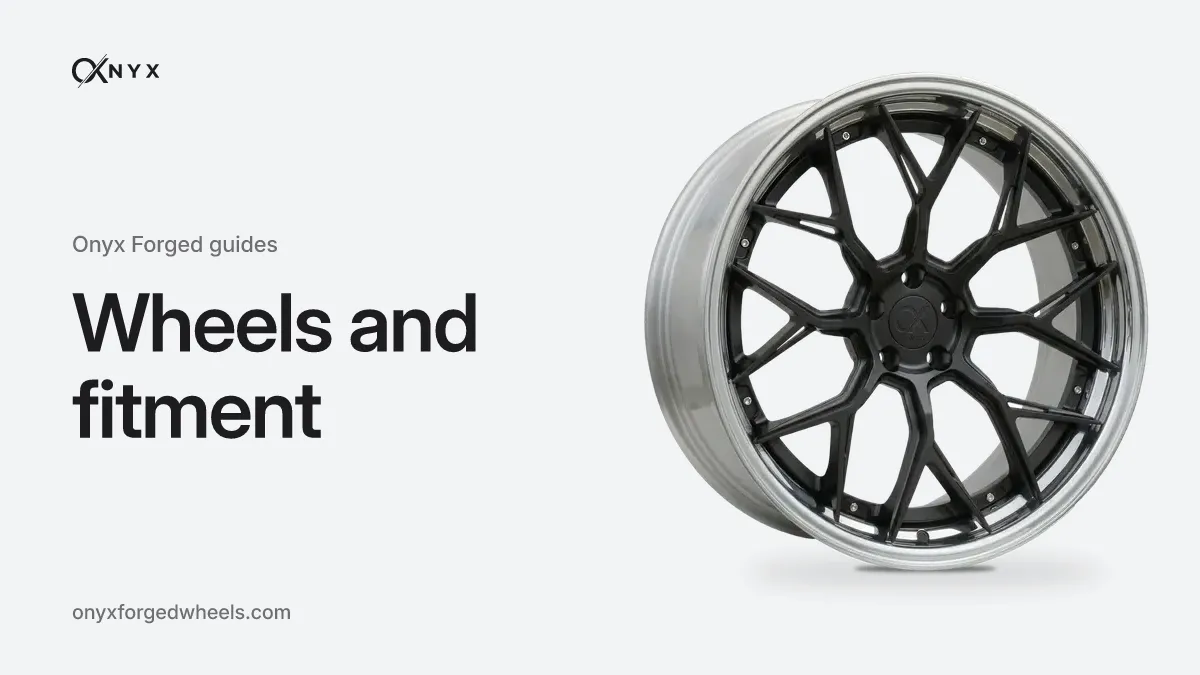
In short. The 911 G-series, 964, 993, 996, 944 and 968 share one hub: a 5x130 PCD (bolt pattern), a 71.6 mm centre bore, and M14 x 1.5 fasteners tightened to 130 Nm. What sets them apart is the set of wheel and tyre combinations Porsche lists in its bulletins: 15 and 16 inches on the 911 G-series and the 944 of 1982 to 1986, up to 17 inches on the 944 of 1987 to 1991, up to 18 inches on the 964, 993, 996 and 968, and no 19-inch wheel in any of the eight bulletins we read. At the French roadworthiness test, the tyre size must be one the carmaker provides for or an accepted equivalent, the wheel must not stick out of the bodywork, and the tyres on an axle must be of the same type. Historic registration in France also expects a car kept in its original condition, and the British MOT exemption expects no substantial change. A made-to-order forged wheel can keep the look of the period: the Onyx Forged design office proposes the width, offset (ET) and diameter, and you approve them before machining.
Six cars, one hub
| Car | Years | Hub | Fasteners | Torque | Summer sizes listed by Porsche |
|---|---|---|---|---|---|
| 911 G-series (including SC and Carrera 3.2) | 1974 to 1989 | 5x130, 71.6 mm centre bore | M14 x 1.5 nuts | 130 Nm | 15 and 16 inches |
| 911 (964) | 1989 to 1994 | 5x130, 71.6 mm centre bore | M14 x 1.5 nuts (one source out of three says bolts) | 130 Nm | 16 to 18 inches |
| 911 (993) | 1994 to 1998 | 5x130, 71.6 mm centre bore | M14 x 1.5 nuts (one source out of three says bolts) | 130 Nm | 16 to 18 inches |
| 911 (996) | 1998 to 2005 | 5x130, 71.6 mm centre bore | M14 x 1.5 bolts | 130 Nm | 17 and 18 inches |
| 944, 1982 to 1986 | 1982 to 1986 | 5x130, 71.6 mm centre bore | M14 x 1.5 nuts (one source out of three says bolts) | 130 Nm | 15 and 16 inches |
| 944, 1987 to 1991 | 1987 to 1991 | 5x130, 71.6 mm centre bore | M14 x 1.5 nuts (one source out of three says bolts) | 130 Nm | 15 to 17 inches |
| 968 | 1991 to 1995 | 5x130, 71.6 mm centre bore | M14 x 1.5 nuts | 130 Nm | 16 to 18 inches |
Hub and fasteners: our car pages as checked on 20 October 2026, each citing its sources (matching specialist databases; for the fasteners, the majority of three sources, or Porsche for the 996). Torque: Porsche bulletins, except the 993, whose bulletin does not give it (130 Nm according to two specialist databases). Sizes: the Porsche bulletins listed at the end of this guide.
Each generation has its own page, in French, with its sizes axle by axle and the source of every figure: the 911 G-series, the 964, the 993, the 996, the 944 of 1987 to 1991 and the 968. The 944 of 1982 to 1986 is covered on the Porsche 944 page, and all of them are on the 5x130 page. Our table of PCDs and centre bores by make covers the later Porsches.
The same 5x130, not the same wheels
The PCD tells you nothing about the offset. For the same 7J x 15 wheel, Porsche gives a rim offset (RO) of 23.3 mm on the 944 of 1982 to 1986, and 52.3 mm on the 944 of 1987 to 1991: a 29 mm difference. Fitted to a 1984 944, a wheel from a 1989 944 therefore sits 29 mm further in, measured from the hub face. Porsche marks the size, the offset and the part number of each wheel on the inner or outer face of the wheel disc: read them before buying a used wheel, as our guide to identifying OE wheels explains.
How Porsche widened the 911 G-series
Porsche's bulletin 76/20 gives, for the 911 from model year 1969, 6J wheels with a 36 mm rim offset (RO) and 7J wheels with 23.3 mm, in 15 and 16 inches; 8J wheels, with 10.6 mm, appear in summer only for the Carrera 3.0 of model years 1975 and 1976, the Turbo and the Carrera "Turbo Look", and in winter, at the rear, for every 911 on 16-inch wheels. Working out where the rim edges sit shows what that means.
| Wheel | Offset (RO) | Inner rim edge, from the hub face | Outer rim edge, from the hub face |
|---|---|---|---|
| 6J | 36 mm | 112.2 mm inboard | 40.2 mm outboard |
| 7J | 23.3 mm | 112.2 mm inboard | 65.6 mm outboard |
| 8J | 10.6 mm | 112.2 mm inboard | 91.0 mm outboard |
Calculated by the design office on the nominal width (1 inch = 25.4 mm): inner edge = half the width + offset; outer edge = half the width − offset. The flanges add a few millimetres on each side.
The inner edge does not move: every inch of width Porsche added goes outwards, towards the wing, 25.4 mm at a time. The same bulletin also asks, on 911s from 1969 to 1977, for the Carrera wing extensions or rear side sections to be welded in before fitting 215/60 R 15 or 225/50 R 16 tyres: the car's width goes from 1,610 to 1,652 mm, 21 mm on each side. Porsche adds that the wheel must stay sufficiently covered at the front and the rear, with suitable parts or other measures.
On a widened body that Porsche never listed (bolt-on wing extensions, body kit), none of Porsche's sizes applies as it stands: the possible width and offset come from the actual wheel arch, not from a table.
Keep the period look, or go to 17, 18 or 19 inches
What the diameter changes
A 185/70 R15, one of the 911 G-series tyres on 15-inch wheels, is 640 mm in overall diameter: 381 mm of wheel and two 129.5 mm sidewalls. To keep those 640 mm on a bigger wheel, the sidewall has to lose 12.7 mm for every inch of wheel diameter.
| Wheel diameter | Wheel | Sidewall that keeps 640 mm |
|---|---|---|
| 15 inches | 381.0 mm | 129.5 mm |
| 16 inches | 406.4 mm | 116.8 mm |
| 17 inches | 431.8 mm | 104.1 mm |
| 18 inches | 457.2 mm | 91.4 mm |
| 19 inches | 482.6 mm | 78.7 mm |
Calculated by the design office. This is not a tyre size we suggest: the table only shows how much sidewall is left.
The 17-inch combination Porsche lists for the 944 of 1987 to 1991 keeps the diameter of its 15-inch one to within 1.3 mm: a 195/65 R15 is 634.5 mm, the 225/45 ZR17 front tyre of the 17-inch combination 634.3 mm, and the 255/40 ZR17 rear tyre 635.8 mm. Our guide to reading a tyre size explains the calculation.
What Porsche asked for before going bigger
Porsche's bulletins attach conditions to several moves to a bigger diameter:
- 944 of 1987 to 1991, 17 inches: for the 944, 944 S and 162 kW Turbo, a sports chassis (the S2 is also allowed with the standard chassis), rubber mounts replaced with part 951.341.023.01, eccentric pins with part 951.341.431.01, flared wing seams, a rear anti-roll bar, and no snow chains any more. The 8J front and 9.5J rear combination is not listed for the cabriolet.
- 944 of 1982 to 1986: bulletin 72/20 gives only 15 and 16 inches. A 1984 944 on 17-inch wheels is outside Porsche's list.
- 964, 17 inches: on narrow-body cars, only the Carrera RS, the Speedster and the RS America, with a limited steering angle (new stop washers) and a front wing seam that must not project over the front apron; on the Turbo and the "Turbo Look" cabriolets, the whole front wing seam must be flanged, "never grind down", and the wheel clearance checked.
- 993, 18 inches: never on the Targa, nor on the cabriolet before model year 1996; before that model year, only coupés within given chassis number ranges, with a transverse strut between the steering gear clamps, and some cars in those ranges lack the body reinforcements 18-inch wheels need.
- 996, 18 inches in 7.5J and 10J: only up to model year 2001.
None of the eight bulletins lists a 19-inch wheel. A 19-inch wheel on any of these six cars therefore means a tyre size Porsche does not give, with the consequences at the French roadworthiness test described below.
Spacers
Several of Porsche's combinations use a spacer: 17 mm at the rear for the 9.5J x 17 wheel of the 184 kW 944 Turbo and of the S2 with the R01 chassis, 17 mm at the rear for the 9.5J x 17 wheel of the 968 coupé, 25 mm at the rear for an 18-inch combination of the 993 Turbo, Carrera S and Carrera 4S. Those spacers are part of the listed combination, with their part numbers. What the rules say about spacers added outside such combinations is in our guide to wheel spacers.
What inspections and registration rules check
At the French roadworthiness test
The inspector examines each fitted wheel, turning it, and records the defects listed in technical instruction IT VL F5 (index G, 18 June 2025). For wheels and tyres:
| Point | What the inspector records | Level |
|---|---|---|
| 5.2.2.d.2 | wheel size, design, compatibility or type not meeting the requirements: wheel sticking out of the bodywork, intermittent or permanent contact with another part | major |
| 5.2.3.a.2 | tyre size, load capacity or speed rating not meeting the requirements | major |
| 5.2.3.b.2 | tyres of different sizes, or of different types, on the same axle | major |
| 5.2.3.f.2 | tyre rubbing, or at risk of rubbing, against a rigid part such as a wing | major |
| 5.2.3.a.3 | load capacity or speed rating too low for actual use, tyre touching a fixed part | dangerous |
The accepted tyre sizes are those the carmaker provides for: the OTC technical database, the carmaker's label, the owner's documentation, the European document of conformity (CoC), a written statement from the carmaker or a tyre manufacturer giving the make and model of the car, its type and the sizes with their load and speed ratings, tyre manufacturers' websites, or the TNPF table of equivalent sizes. The load index and the speed rating must be at least those the carmaker provides for.
Two provisions apply only to cars registered as historic vehicles. Their tyres may show, on at least one sidewall, only the make, the size, the construction and the date of manufacture. And a cracked wheel is a major defect on them, where it is a dangerous one on other cars.
French registration
According to Service-public, a change affecting the characteristics in the car's technical description (power, weight and dimensions, axles, brakes, steering…) or its bodywork must be declared within a month, to update the registration document. Wheels are not on that list; widened wings change one of the car's dimensions, its width.
French historic registration
The French road traffic code (article R311-1, point 6.3, in force since 25 July 2026) defines a historic vehicle by three conditions: built or first registered at least thirty years ago, of a type no longer produced, and preserved historically and kept in its original condition, with no essential change to the technical characteristics of its main components. Service-public sums up that last condition as not having had its technical characteristics changed. The supporting statement comes from the carmaker or from the FFVE, the French federation of historic vehicles, which names the main components as the mechanical parts, the body and the number of seats. None of these texts mentions wheels.
Historic registration is neither automatic nor compulsory. For a car first registered on or after 1 January 1960, it stretches the interval between two roadworthiness tests to five years (article R323-22). In 2026, every 911 G-series, 964, 944 and 968 is at least thirty years old; a 993 whose build year is 1996 or earlier gets there this year at the latest, one whose build year is 1997 or 1998 in 2027 or 2028, and a 996 (model years 1998 to 2005) not before 2027.
In Great Britain
GOV.UK says a car does not need an MOT if it was built or first registered more than 40 years ago and no substantial change has been made to it in the last 30 years. The main components it lists are the chassis or frame, the monocoque bodyshell, the axles and running gear (where a change in the type or method of suspension and steering counts as substantial) and the engine. A change does not count if the original type parts are no longer reasonably available, if it is of a type made while the model was in production or within 10 years of its end, or if axles and running gear were changed to improve efficiency, safety or environmental performance. Wheels are not named, and an exempt car must still be kept roadworthy. In 2026, a 911 G-series or a 944 built more than 40 years ago can qualify; a 964 (model years 1989 to 1994) not before 2028. A car that still takes the MOT is covered by our guide to new wheels and the MOT.
Brakes and caliper clearance
The eight bulletins we read give no caliper dimension: a combination applies to a version as Porsche delivered it. If the brakes have been changed (calipers from a more powerful version, a kit), the minimum wheel diameter and the room behind the spokes depend on the caliper actually fitted, not the one in the catalogue. The design office takes it into account before proposing dimensions: a photo of the fitted wheel is enough to spot a caliper that is not the original one. Our guide to caliper clearance explains the two measurements.
Tyres: N marks, age and period sizes
In each of its bulletins, Porsche asks for tyres of the same make, type, speed rating and specification code (N0, N1, N2…) on the whole car, the full code being shown on the sidewall. The French test instruction does not mention these codes: it checks the size, the ratings, the construction and the same type on an axle. Our guide to carmaker tyre markings explains N marks.
For the 911 from model year 1969, the bulletin of 30 July 2021 still lists tyres in period sizes:
| Sizes | Tyres listed (N code) |
|---|---|
| 185/70 R15 89W all round, or at the front with 215/60 R15 94W at the rear | Pirelli P 6000 (N3) |
| 185/70 VR 15 front, 215/60 VR 15 rear | Pirelli CN36 (N5) |
| 185/70 R15 89V front, 215/60 R15 94V rear | Dunlop Sport Classic (N0) |
| 195/65 R15 91W all round, or at the front with 215/60 R15 94W at the rear | Pirelli P 6000 (N3) |
| 195/65 R15 91W front, 215/60 R15 94V rear | Dunlop Sport Classic (N0) |
| 205/50 ZR15 front, 225/50 ZR15 rear (911 Carrera 3.0 and 3.0 Turbo, model years 1975 and 1976) | Pirelli P7 Cinturato (N5), Pirelli P Zero Trofeo R (N0) |
| 205/55 ZR16 all round | Continental ContiSportContact (N2), Michelin Pilot Exalto 2 (N0), Pirelli P Zero Rosso Asimmetrico (N5) |
| 205/55 ZR16 front, 225/50 ZR16 rear | Pirelli P Zero Rosso Asimmetrico (N5), Continental ContiSportContact (N2), Michelin Pilot Exalto 2 (N0), Pirelli P7 Cinturato (N4) |
| 205/55 ZR16 front, 245/45 ZR16 rear | Yokohama 8008P (N0), Pirelli P Zero Rosso Asimmetrico (N5) |
Porsche bulletin 76/20, summer tyres, read on the pages of the document. The 911 Turbo (930) has its own lines.
The 964 and 993 bulletins also list tyre types in 16, 17 and 18 inches; the 944 bulletins give sizes only. Porsche also asks for tyres more than 6 years old to be replaced, and points out that a tyre left unused for a long time hardens and turns brittle faster than one in use. Our guide to tyre age shows how to read the date of manufacture. Finally, the bulletins rule out repairing V, W, Y or ZR tyres.
Load per wheel
UNECE Regulation No. 30 (annex IV) turns the load index on a sidewall into kilograms. The 15-inch tyres Porsche lists for the 911 give an idea:
| Tyre | Index | Load per tyre | Load for both tyres on an axle |
|---|---|---|---|
| 185/70 R15 89W | 89 | 580 kg | 1,160 kg |
| 195/65 R15 91W | 91 | 615 kg | 1,230 kg |
| 215/60 R15 94W | 94 | 670 kg | 1,340 kg |
The "ZR" tyres in the bulletins (205/55 ZR16, 225/40 ZR18…) carry no index there: "ZR" marks a tyre designed for more than 240 km/h (Regulation No. 30, paragraph 3.1.3.4). At the French test, the load index must be at least the one the carmaker provides for; without that information, it must match a load above the maximum permissible load on the axle.
The wheel carries everything the tyre carries. The Japanese JWL standard works it out, by default, from the highest capacity of the tyres intended for it (attachment 2 of the Japanese Ministry of Transport, paragraph 2.1.1). The Onyx Forged design office checks the permissible load together with your car's other dimensions, before manufacture; we do not publish a load figure per wheel. Our guide to wheel load ratings goes through the calculation.
Original restoration or restomod
Two approaches meet on these cars. An original restoration takes the car back to how it was delivered: a combination Porsche lists for the version, tyres of listed types, the offsets in the bulletin. That is what French historic registration aims at, and it is also FIVA's definition of a historic vehicle (FIVA is the international federation of historic vehicles): at least thirty years old, preserved and maintained in a historically correct condition, not used for daily transport (FIVA Technical Code, point 1.3). FIVA calls a car aged 20 to 29, in good condition and used mostly for leisure, a youngtimer (point 1.4): a 996 today, like a 1997 or 1998 993.
The FIVA code also sorts modifications: period modifications, made during the car's period; period type modifications, made later but typical of the period, using parts to period specification; and non-period type modifications. The period runs from the build year to fifteen years later (point 2.13): from 1984 to 1999 for a 1984 944. A car only counts as "substantially modified" with at least three non-period items among the body, engine, drivetrain, steering, suspension and brakes (point 7.2.2); wheels are not on that list.
A restomod accepts the gap: a bigger diameter, today's tyres, revised brakes and suspension. The car then leaves Porsche's lists. The tyre size becomes a question for the roadworthiness test, a change of dimensions one for the registration document, and a change to the main components one for historic status. These are choices to make before ordering, with the texts in hand; in France, the FFVE offers an eligibility opinion to check restoration choices before committing to them.
The best-known 911 wheel has its own story. According to Porsche, the aluminium wheel fitted to the 911 S from model year 1967 came from Otto Fuchs KG, of Meinerzhagen: a one-piece forged blank, whose whole rim was then rolled, to a specification that asked for about three kilograms less than a steel wheel. The name "Fuchs" refers to that wheel: it is not the name of any Onyx model.
A made-to-order forged wheel on a classic Porsche
Our wheels are designed to JWL/VIA standards. Each set is forged for one car: Onyx Forged does not recommend an offset or a size; the Onyx Forged design office proposes the width, offset (ET) and diameter from the exact version of your car, and sends them to you before machining. For a classic, we ask for one thing only, the registration document (or the chassis number); if the body or the brakes have been changed, a photo of the fitted wheel is enough. The design office works out the rest.
A period look can be drawn: a flat or shallow face, five wide spokes, a polished, brushed or painted finish. A particular design, for example a raised ring around the five nuts, is a request for the design office through the contact page, with photos; customer service then tells you what can be done on your dimensions. No catalogue design is promised in advance for a given car. What "designed to JWL/VIA standards" means is explained in our guide to wheel markings.
Frequently asked questions
Is a 1984 944 on a 5x130 PCD?
Yes: the sources we read give 5x130 and a 71.6 mm centre bore for the whole range, from 1982 to 1991, with M14 x 1.5 nuts tightened to 130 Nm. Porsche's bulletin for that series (72/20) lists 15 and 16-inch wheels only.
Can wheels from a 1987-on 944 go on a 1984 944?
The PCD is the same, the offset is not: 52.3 mm against 23.3 mm for a 7J x 15 wheel according to Porsche. The wheel would sit 29 mm further in, measured from the hub face.
Can a 911 G-series go to 19 inches?
Porsche lists only 15 and 16-inch wheels for the 911 up to 1989, and none of its bulletins lists a 19-inch wheel. At the French roadworthiness test, the tyre size must then appear in one of the accepted sources, such as the table of equivalent sizes or a written statement from a carmaker or a tyre manufacturer with the ratings; if not, it is a major defect.
What does a widened body change?
None of Porsche's combinations applies to it as it stands. For its own wing extensions, Porsche gives a width going from 1,610 to 1,652 mm; in France, a change of dimensions must be declared to update the registration document. The design office starts from the identified car and a photo of the fitted wheel, and sends you the dimensions before machining.
Do I need N-marked tyres?
Porsche asks for the same type and the same N code on the whole car. The French test instruction does not mention N codes: it checks the size, the load and speed ratings and the same type on each axle.
What torque for the wheels of these Porsches?
130 Nm according to Porsche's bulletins for the 911 G-series, 964, 996, 944 and 968, and according to two specialist databases for the 993, whose bulletin does not give it.
Does French historic registration rule out bigger wheels?
The road traffic code does not mention wheels: it expects a car kept in its original condition, with no essential change to the technical characteristics of its main components, which the FFVE lists as the mechanical parts, the body and the number of seats. The FFVE offers an eligibility opinion to check restoration choices before committing to them.
Does a classic Porsche still need an MOT in Great Britain?
Not if it was built or first registered more than 40 years ago and has had no substantial change in the last 30 years, according to GOV.UK; it must still be kept roadworthy. Wheels are not named among the main components.
Why replace tyres that still have tread?
Porsche asks for tyres more than 6 years old to be replaced, and points out that a tyre left unused for a long time hardens and turns brittle faster.
Can I ask for a period design on a made-to-order forged wheel?
Yes, through the contact page, with photos of the car: the design office tells you what can be done in the room left by the caliper and the offset. We do not promise a particular catalogue design for a car before seeing its dimensions.
Made-to-order wheels
At Onyx Forged, the dimensions of your set are those of your car, sent to you in writing before manufacture. The configurator lets you put a set together, the catalogue shows the designs, and our home page sets out the offer. For a project outside the catalogue, write to customer service through the contact page.
Sources
- Porsche Cars North America, tyre, wheel and spacer bulletins filed with NHTSA: 76/20 (911, 912 and 911 Turbo, 1965 to 1989), 58/20 (964), 62/20 (993), 64/20 (996), 65/20 (996 Turbo), 72/20 (944, 1982 to 1986), 28/21 (944, 1987 to 1991) and 59/20 (968), 2021 versions.
- UTAC-OTC, technical instruction IT VL F5, index G, 18 June 2025 (in French).
- Service-public.fr, modified vehicles and registration, checked on 10 January 2025 (in French).
- Légifrance, French road traffic code, articles R311-1 (point 6.3, in force since 25 July 2026) and R323-22 (in French).
- Service-public.fr, historic vehicle registration, checked on 19 June 2026 (in French).
- FFVE, ordering historic registration and eligibility opinion (in French).
- FIVA, Technical Code of 15 November 2025, points 1.3, 1.4, 2.13, 7.1 and 7.2.
- GOV.UK, Historic (classic) vehicles: MOT exemption criteria, updated 19 May 2026, and Historic vehicles: MOT and vehicle tax.
- Porsche Newsroom, 911 Targa Heritage Design Edition and the Fuchs wheel, 2020.
- UNECE Regulation No. 30 on tyres, paragraph 3.1.3.4 and annex IV.
- Japanese Ministry of Land, Infrastructure, Transport and Tourism, attachment 2, standard for light alloy wheels, paragraph 2.1.1 (in Japanese).
The Onyx Forged design office.


